What Is the Mind? — The Quiet Answers Philosophy Has Built Up: Chapter 7 When Plato Meets Japanese Thought — The Deepening of the Sacred Blank
日本語 | English | 繁體中文(台灣) | 簡体中文 | 한국어 | Tiếng Việt
Hello everyone. This is Akira.
Up to the previous chapter, we have carefully traced Plato’s thoughts. The mind continues to seek the “perfect essence (Idea)” in this imperfect world. The power to strive toward that essence is easily replaced by various “ideal copies” in modern daily life, making the mind prone to exhaustion. And by intentionally creating a “sacred blank,” the mind has the possibility of regaining its original direction.
This time, let us quietly overlay Plato’s perspective with the gaze toward “blankness” and “stillness” that Japanese thought has long cherished.
The power of the mind that Plato speaks of lies in the orientation to aim for “what is more true and better.” On the other hand, much of Japanese thought has found the source of recovery and creation in “nothingness” and “blankness itself.”
In Zen meditation, the time spent simply sitting and letting go of thoughts and judgments is emphasized. There, rather than “trying to gain something,” a quiet clarity resides in the state of “holding nothing.” Additionally, the aesthetic of “margin” or “blank space” common in Japanese gardens, tea rooms, calligraphy, and haiku is thought to give birth to deep taste and insight precisely in spaces that are not overly filled.
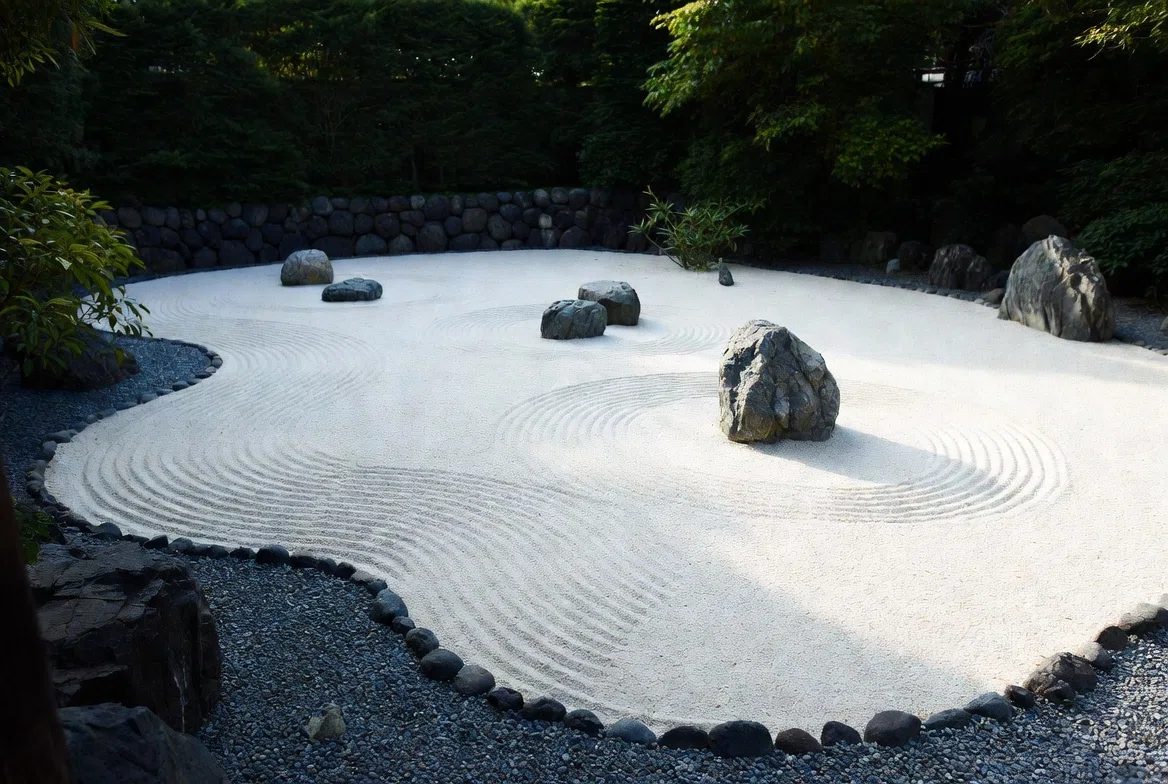
These two gazes do not seem to be in opposition, but rather in a relationship that complements each other.
Plato’s “power to seek essence” teaches us that the mind is not merely passive, but somewhere strives for “a better way of being.” On the other hand, Japanese thought’s “posture of accepting blankness without fear” plays the role of protecting the mind from exhaustion and gently realigning it when that striving becomes too strong.
In the time of the sacred blank, we can re-question “Is this really necessary now?” This is both a Platonic act of “seeking essence” and a Japanese act of “letting go and allowing blankness.” When the power of both overlaps, the mind does not merely rest, but becomes better able to find the direction that is truly important to itself.
The practice of the mind’s garbage dump also has the same two aspects. By temporarily setting aside the imperfect copies we were chasing, miscellaneous expectations, comparisons, and unfinished thoughts (letting go), room is created in the head and heart. In that room, the question “What is truly important?” naturally rises to the surface. This is not simply thinking about nothing, but a manifestation of the mind’s power to realign itself in the blank.
For us living in the modern world, holding both of these perspectives is very practical.
Seeking “what is more true” like Plato, while accepting “blankness without fear” like Japanese thought — that balance helps ease brain fatigue and mental exhaustion, and helps the mind regain its original softness and clarity.
Of course, there is no need to lean toward one side. What is important is to gradually find the form of “sacred blank” that feels comfortable to you. Five minutes in the morning, the time spent gazing out the window on the train, short breaks between work… By accumulating these small blanks, the mind gradually recovers from exhaustion and moves closer to the direction it originally wanted to head.

The next chapter is the final chapter. We will quietly summarize the accumulation of philosophy we have traced so far as a whole, and how we can apply it in daily life.
Please look forward to it!
Akira
👤 Profile: https://discipline.tokyo/profile.php
📧 Email: akira@discipline.tokyo
📮 Anonymous Consultation Form: https://discipline.tokyo/contact.php
📚 Summary of All Activities: https://discipline.tokyo/index.php
※ This series and related content are the crystallization of my thoughts and are protected by copyright law. Please clearly indicate the source when quoting. Unauthorized reproduction or commercial use is prohibited.
© 2026 Akira All Rights Reserved.

QRコードで即追加 → 秘密の回廊が開く