Making the Heart Lighter with Shinto and Buddhism: Chapter 4 The World of Myths and Stories
*This series is planned to conclude with a total of 9 chapters + appendix.
日本語 | English | 繁體中文(台灣) | 簡体中文 | 한국어 | Tiếng Việt
Hello everyone. This is Akira.
In the previous chapter, we saw how Shinto and Buddhism met and blended together throughout history.
So, what kind of stories did people weave during that long period of time?
Myths and stories are not just old tales.
“How did this world begin?”
“Where does suffering come from?”
“What should we value in life?”
I feel that they have quietly tried to answer such questions.

The World Depicted in Shinto Myths
At the center of Shinto myths are the stories recorded in the Kojiki and Nihon Shoki.
From the chaos where heaven and earth had not yet separated, gods were born one after another, and the land was created.
Izanagi-no-Mikoto and Izanami-no-Mikoto gave birth to the land, and later, from Izanagi-no-Mikoto’s purification, Amaterasu-Ōmikami and Susanoo-no-Mikoto were born.
These stories are filled with a deep reverence for nature and a sense of cherishing “life.”
At the same time, a strong awareness of death and impurity is also depicted.
The scene in which Izanagi-no-Mikoto performs purification after returning from Yomi (the underworld) vividly shows the feeling of trying to protect “the pure world of life.”
Shinto myths may give us a perspective to carefully look back at “the world that exists here and now.”
What Buddhist Stories Illuminate
On the other hand, Buddhist stories touch the heart from a slightly different angle.
The life of Shakyamuni Buddha, stories about “what form the Buddha lived in previous lives,” depictions of the Pure Land of Ultimate Bliss, and so on.
There, questions such as “Why does suffering arise?” and “How can the heart become free?” are repeatedly told.
The importance of compassion and letting go of attachment.
Such teachings have reached people’s hearts in the form of stories.
While Shinto myths depict “connection with this world,” Buddhist stories quietly point to “liberation from the suffering of this world.”
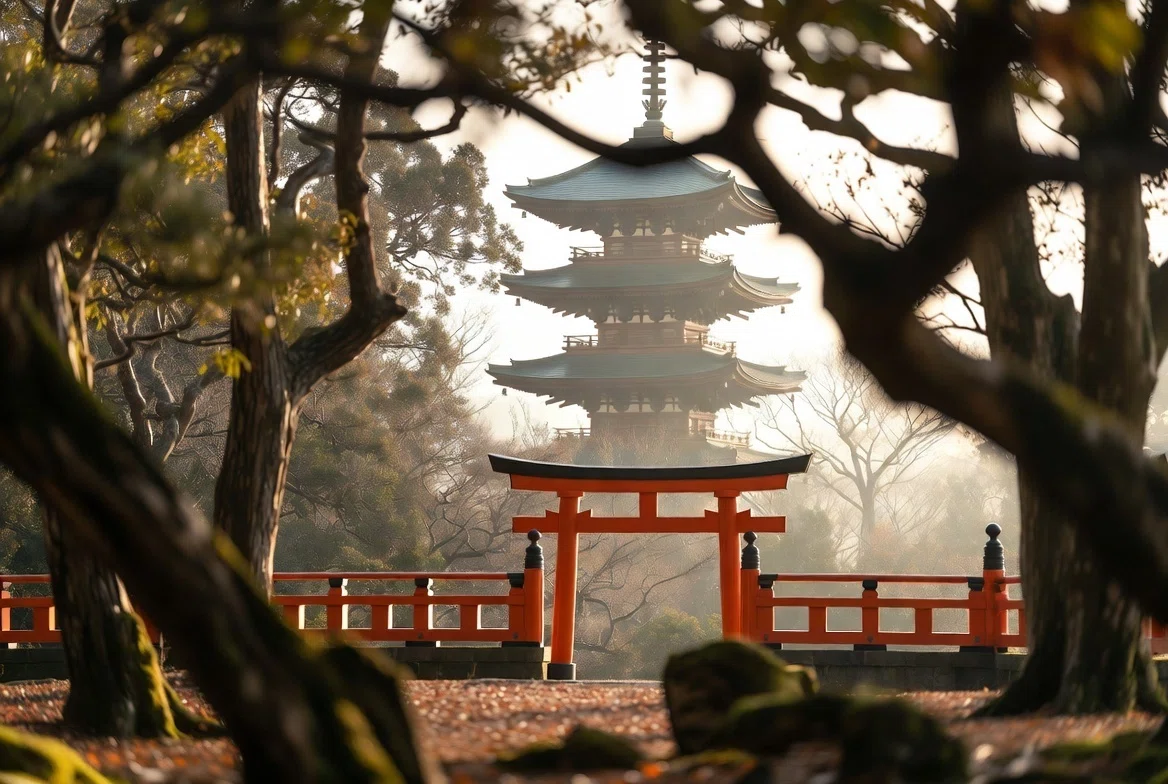
The Two Worlds of Stories Living in the Same Land
In Japan, the worlds of these two sets of stories have coexisted in the same place for a long time.
The stories of the gods told at shrines, and the stories of the Buddha told at temples.
Sometimes, gods and the Buddha even appear in the same story.
Under the idea of Honji Suijaku, it was said that the gods were the Buddha appearing in temporary forms.
People did not choose to accept only one set of stories as correct, but quietly opened both sets of stories in various scenes of their lives.
When they wanted to feel a new beginning, they turned to the stories of the gods; when their hearts were heavy and they could not move, they turned to the stories of the Buddha.
In this way, stories too may have gently illuminated different parts of the heart.
For Us Living in the Present
When we suddenly stop and feel like asking,
“Where did I come from, and where am I heading?”
Myths and stories quietly stand by our side.
Shinto myths remind us of ourselves living within nature,
Buddhist stories give us a gentle trigger to let go of the restlessness deep in our hearts.
Both touch places deep in the heart that we might not notice if we are simply “just living.”
In the next chapter, I would like to look at the differences between shrines and temples as actual places we visit.
Please look forward to it!
Akira
👤 Profile: https://discipline.tokyo/profile.php
📧 Email: akira@discipline.tokyo
📮 Anonymous Consultation Form: https://discipline.tokyo/contact.php
📚 Summary of All Activities: https://discipline.tokyo/index.php
※ This series and related content are the crystallization of my thoughts and are protected by copyright law. Please clearly indicate the source when quoting. Unauthorized reproduction or commercial use is prohibited.
© 2026 Akira All Rights Reserved.

QRコードで即追加 → 秘密の回廊が開く