You Could Be Detained Just for Transiting Through a Chinese Airport — July 1: The Real Cost of “Freedom” That Japanese People Have Overlooked
【Genre】Ethics, Philosophy
日本語(original) | English version | 繁體中文(台灣)版 | Tiếng Việt
Hello everyone. This is Akira.
On July 1, 2026, China’s “Ethnic Unity and Progress Promotion Law” will come into effect.
When you first heard the name of this law, did you think, “Oh, just another piece of China’s domestic policy”?
However, as I read through the materials, I felt a chill run down my spine.
This law criminalizes any movement aimed at protecting the languages or cultures of ethnic minorities as “separatism.”
It extends to education, publishing, the internet, and corporate activities. Furthermore, under Article 63, even “criticism of China” made by individuals living in Japan can be subject to legal liability through extraterritorial application.
There have already been precedents under the Hong Kong National Security Law where students returning to China were arrested for social media posts made while in Japan.
Reports from international investigations have also revealed that China operates secret police bases in Tokyo’s Akihabara, where they conduct “persuasion” by holding family members hostage.
For companies, it is a “trap with no exit.”
If you investigate the possibility of forced labor, you may be accused of “inciting ethnic separatism.” If you try to withdraw, you risk being banned from leaving the country.
They welcome investment while sealing off the exit.

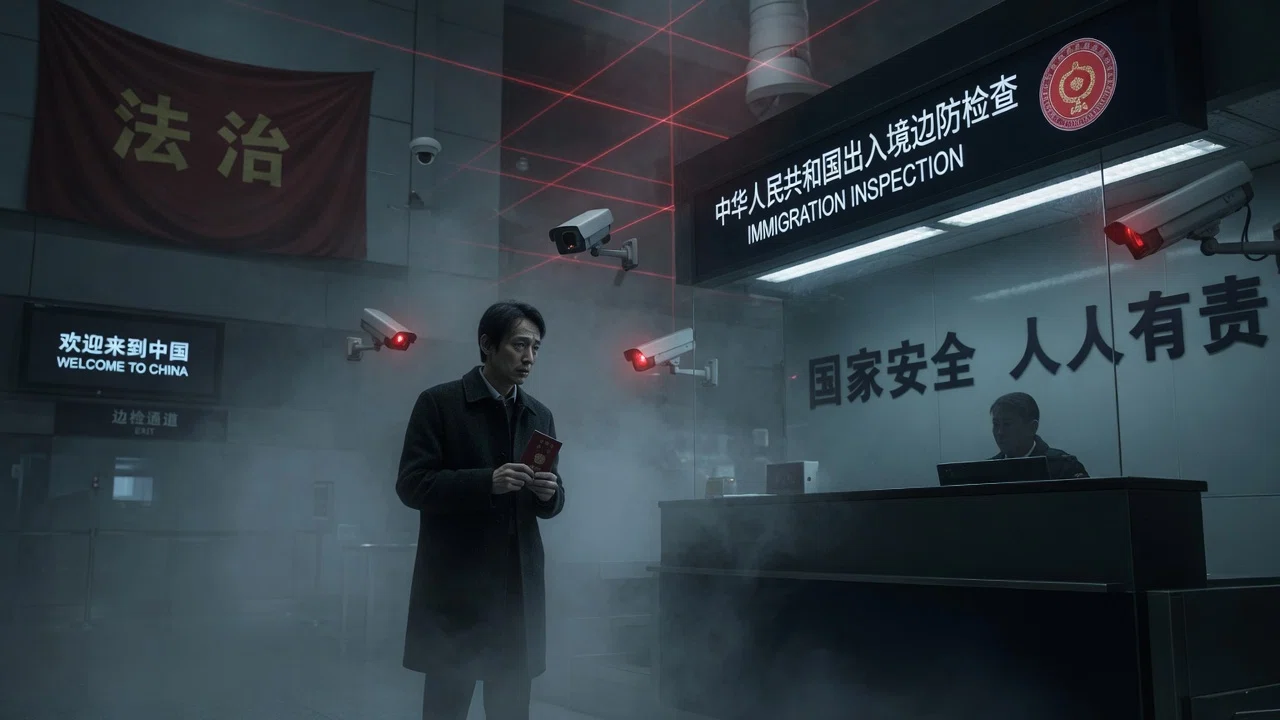
However, what is most ethically serious is the danger that could affect ordinary Japanese travelers during airport transit.
The moment you step into Shanghai or Beijing airports while transferring flights to Europe or Southeast Asia, your past blog posts or social media comments could be deemed as “inciting ethnic separatism,” and you could be detained on the spot.
According to the materials, Hong Kong cases have applied this logic even to posts made two years earlier.
This new law further expands that logic, making it possible to treat “legitimate criticism” regarding ethnic minorities or religious issues as a crime, even against individuals located outside China.
——Does this mean that every time you transit through a Chinese airport for family trips or business travel, you must check and delete your own history of words?
This is no longer a problem only for those who actively criticize China.
Anyone who has ever used the words “human rights” or “ethnic minorities,” or even simply shared news, now carries the risk of being detained, interrogated, or having their family taken hostage at the airport.
Here, the issues of ethics and human rights come sharply into focus.
Freedom of expression is not merely the “right to say what one wants.”
It is rooted in the fundamental human dignity that allows people to think, to follow their conscience, and to respond in words to the suffering of others.
This law attempts to seize that dignity across borders in the name of national sovereignty.
Philosophically, what we must question is the ethical meaning of “remaining silent.”
Silence can sometimes be a chosen form of “defensive non-action” that protects inner freedom.
However, when silence is forcibly imposed through fear, it is no longer a choice of one’s own will.
At that point, we stop thinking and voluntarily abandon raising our voices in accordance with our conscience.
As Hannah Arendt said about totalitarianism, the most dangerous thing is when power deprives people of their “ability to think.”
Under this law, telling yourself “I’ll just pretend not to know about China” or “I’ll avoid Chinese airports” already represents a shrinking of thought.

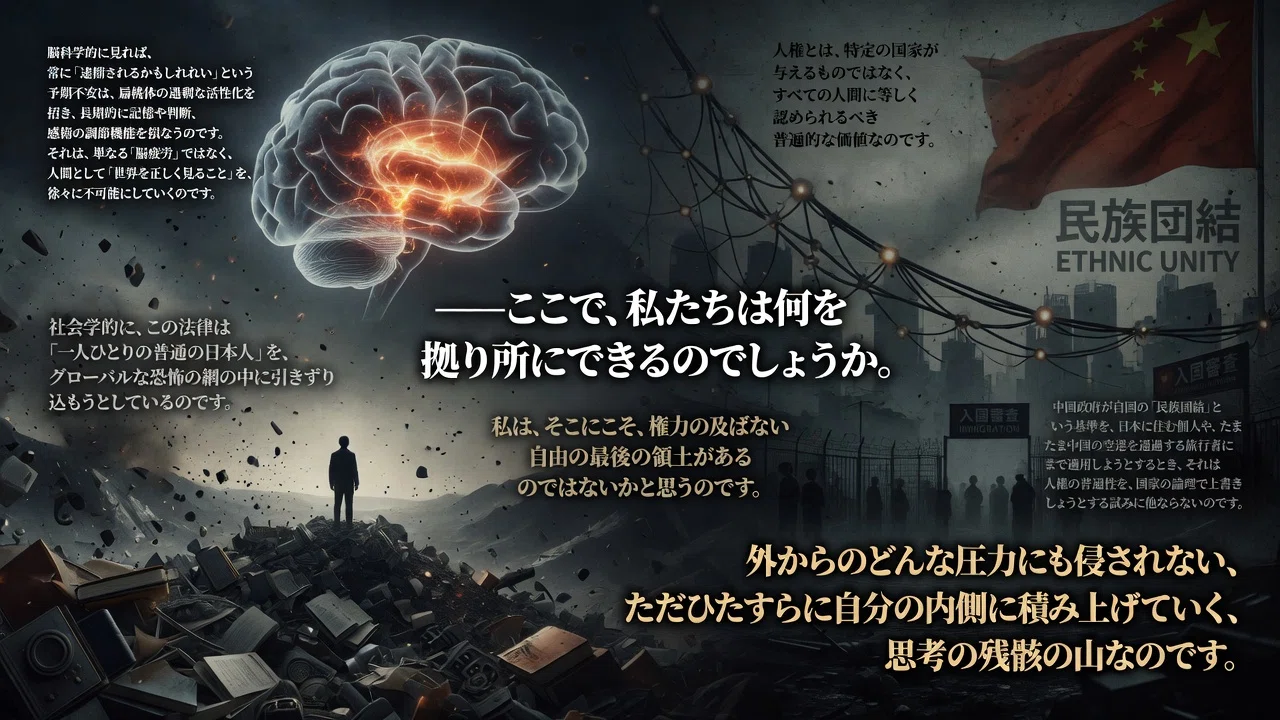
Sociologically, this law attempts to drag “ordinary Japanese people” into a global web of fear.
Human rights are supposed to be universal values equally recognized for all human beings.
Yet the Chinese government is trying to apply its own standard of “ethnic unity” even to individuals living in Japan and to travelers transiting through its airports.
This is nothing less than an attempt to overwrite the universality of human rights with the logic of the state.
——So what can we rely on here?
I believe that what exists is an inner territory that power cannot reach.
It is a mountain of the remains of thought that one continues to accumulate deep within oneself, no matter what external pressure comes.
If you don’t mind, I would like to ask you as well.
What kind of words are accumulating inside you right now?
After July 1, what will you be able to continue adding there?
——That answer cannot be forced by anyone.
All that remains is to quietly keep asking the question to yourself.
Akira
👤 Profile: https://discipline.tokyo/profile.php
📮 Anonymous Consultation Form: https://discipline.tokyo/contact.php
📚 All Activities Summary: https://discipline.tokyo/index.php
※ This series and related content are the crystallization of my thoughts and are protected by copyright law. Please clearly indicate the source when quoting. Unauthorized reproduction or commercial use is prohibited.
© 2026 Akira All Rights Reserved.

QRコードで即追加 → 秘密の回廊が開く